
Washington Nationals Philanthropies Snapshot
Since 2014, the Nationals Youth Baseball Academy has served more than 6,000 kids in Washington, D.C., ages 5 to 18, with free after-school programming built around academics, character development, and access to baseball and softball. It's a building they run, with staff, a curriculum, and a campus in Southeast D.C. On top of the youth programming, the Academy runs a weekly produce market and a healthy food store, and between those and its distribution programs, Nationals Philanthropies is getting more than 100,000 meals a year to families in the surrounding community.
That's the piece of the organization that shows up when you look at what I call "Community Dollars Deployed," which combines actual grants with the true non-grant cost of running direct programs. In 2024, over 92% of that figure came from the Academy itself. This is a foundation that decided a decade ago to build and operate something rather than fund other people's programs, and the data backs up that it worked.
That focus shows up in the IMPACT+ score too. Washington comes in at #9 of 29 in my rankings, well above league average. For a franchise that ranks in the middle of the pack on valuation (#15) and team revenue (#16), that's a foundation punching above its market size, and the Academy is why.
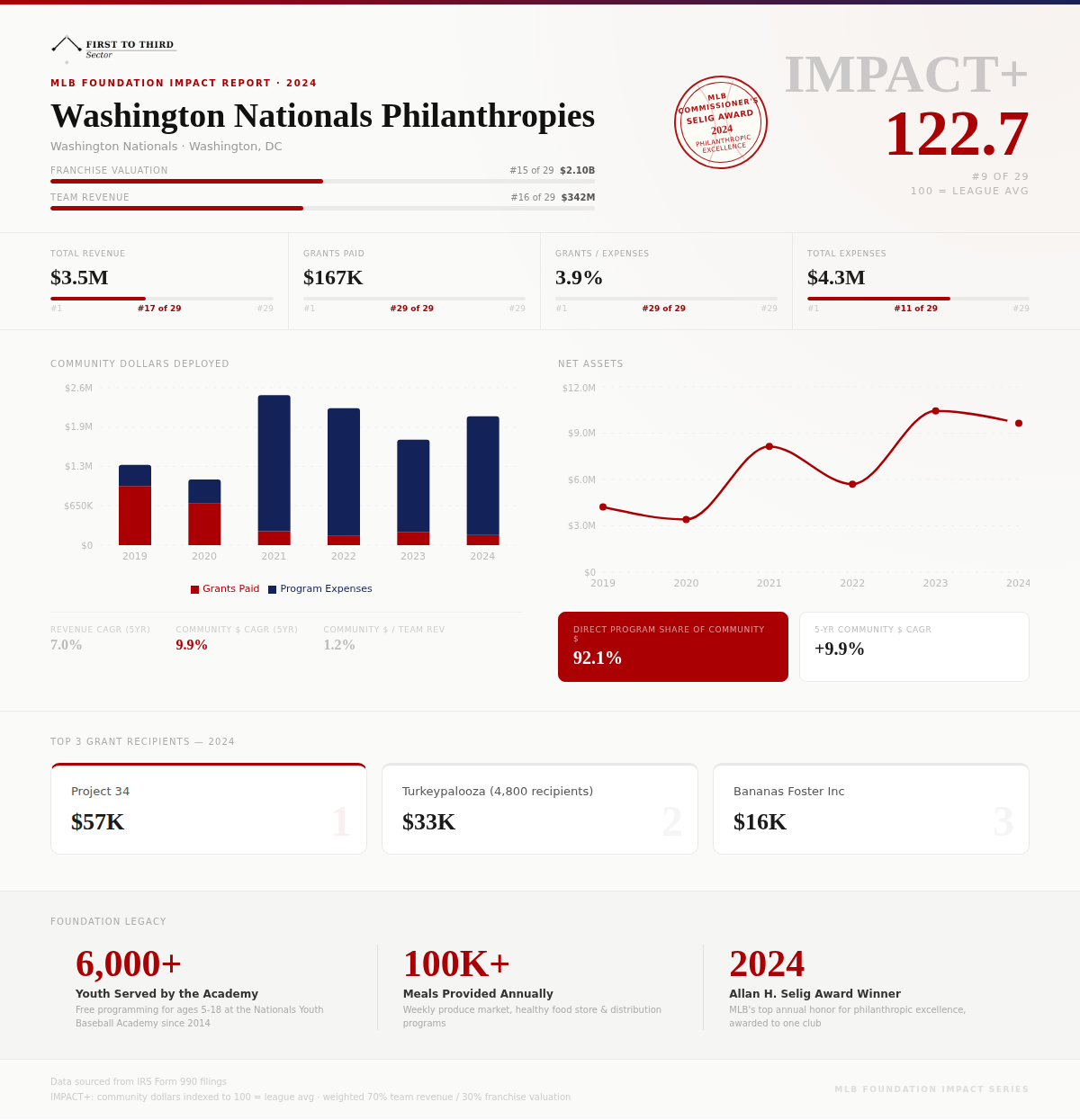
In December 2024, the Nationals won the Allan H. Selig Award for Philanthropic Excellence, the league's top annual honor for a club's community work, specifically for the Academy's decade of youth programming and its food security efforts.
The last piece worth addressing directly is the balance sheet. Nationals Philanthropies is sitting on $9.6 million in net assets, good for #10 of 29 league-wide, comfortably in the top third. For other foundations, I've questioned the need for such a large asset base, but for a foundation that operates a physical facility, with a food market, a store, and programming that runs year-round regardless of how any single fundraising year goes, it makes a lot more sense. Running the Academy means covering staff salaries, maintaining equipment, and keeping the lights on through good years and bad. I can see the need to have such a buffer that lets a program-operating foundation keep its doors open without having to scale back the moment revenue softens.