
Mariners Care Snapshot
I'm trying to find a positive for this one. There are some green shoots here, but the top line is not a great look.
You have a team that is in the top half of the league in valuation and revenue. They are in a solid market. Their lead owner, John Stanton, is philanthropic in his own right through the Aven Foundation, which gave away over $9M in grants in 2024. But when you look at the data, none of it reflects well on the club's commitment to the foundation. It starts with their revenue, which comes in dead last of the 29 foundations I am looking at, and so it then makes intuitive sense that their IMPACT+ score is 31.7, good for #27 of 29. This is a foundation with little money coming in and going out, and the score reflects that accurately.
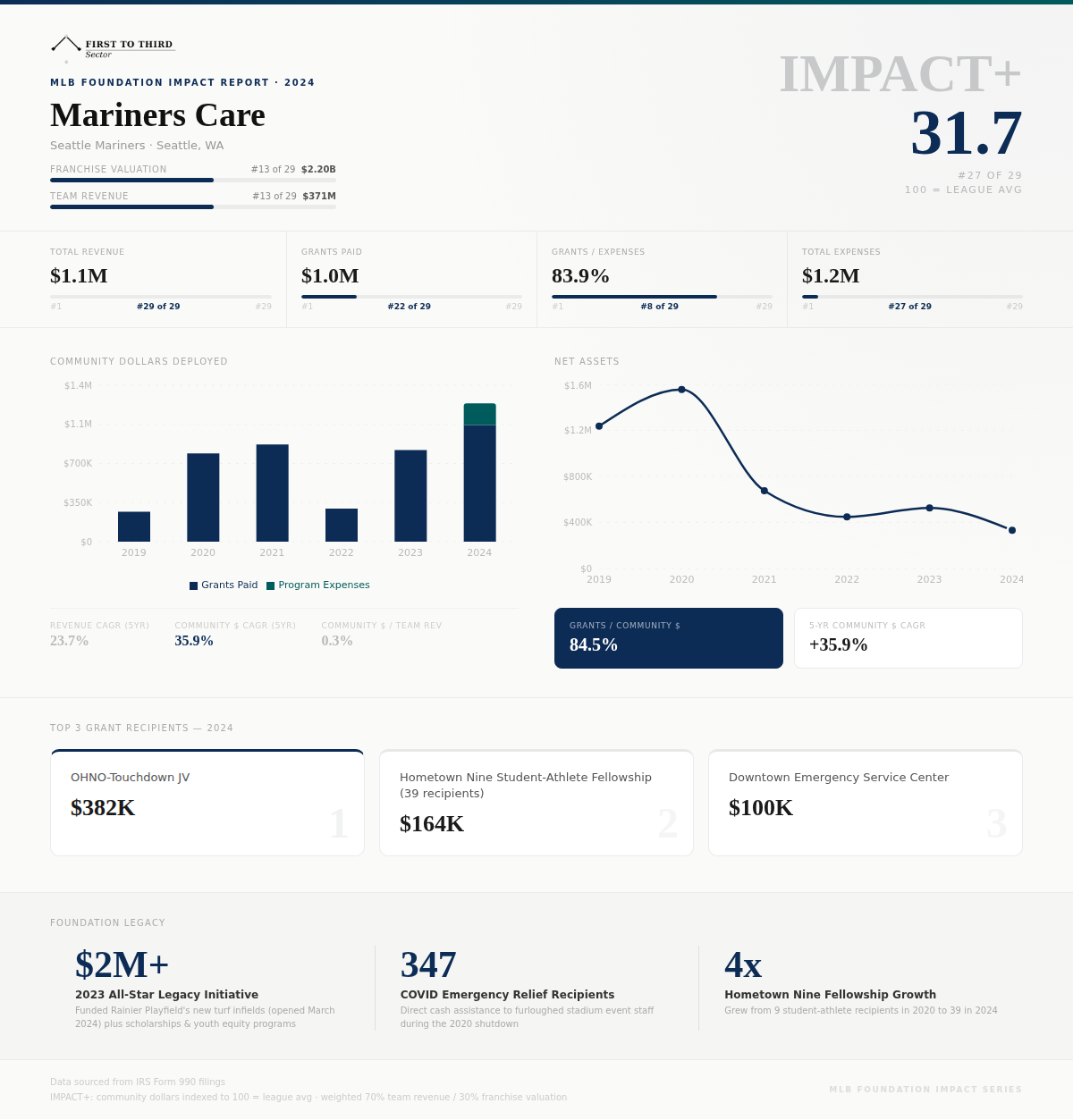
From an operating standpoint, Mariners Care operates mainly as a pass-through grantmaker, with the Hometown Nine Student-Athlete Fellowships as the main non-grant programmatic expense. I don't want to minimize this program with my overall criticism of the Foundation. It's a great program that has a vision for what it means to make an impact in a young person's life. From their website:
"The Hometown Nine is a five-year commitment to nine incoming eighth-graders in King, Pierce and Snohomish Counties. The program provides financial, academic, professional and social support to Hometown Nine Fellows to encourage success in their athletic careers and educational journeys. Mariners Care Foundation, the official nonprofit foundation of the Seattle Mariners, underwrites the playing fees for elite baseball and softball training, offering Hometown Nine Fellows equitable access to competitive play.
In conjunction with athletic support, each Fellow is paired with a Mariners Front Office staff who serve as mentors. They meet quarterly to provide academic and professional guidance. As the Hometown Nine Fellows near high school graduation, they will participate in events tailored to future academic pursuits, including college admissions prep, essay writing support and more."
The program was launched in 2020, and given its long-term nature, the first class just graduated, with a 100% graduation rate, 17 percentage points higher than the Washington state average. That is not nothing, and Mariners Care should be commended for putting together such a program.
Yet, they are missing opportunities to have an even greater impact. For example, let's take how Seattle handled hosting the 2023 All-Star Game. MLB, the Mariners, and Mariners Care together committed more than $2 million to the All-Star Legacy Initiative, funding new turf infields at Rainier Playfield (which opened in March 2024) along with scholarships and youth equity programs. On its own, this sounds great. However, compared with every other host club going back to 2012, that's the smallest commitment on record for the All-Star Legacy Initiative, excluding 2020's pandemic-shortened $1.7 million. Every other year in the dataset, going back over a decade, saw a bigger investment than Seattle made in its own host year.
On the other hand, there is evidence beyond the Hometown Nine program that the Foundation is becoming more invested, as community dollars deployed grew at a 35.9% five-year CAGR from 2019-2024. But it's growth off a small base, from $267,097 in 2019 to $1.24 million in 2024 (and this includes money from the All-Star Legacy Initiative so it may be inflated). But if revenue doesn't increase in step, there won't be much more room to grow as they don't have any real asset base to draw on. They spent much of it down during the pandemic despite a crash in revenue. That year, the Foundation still paid out $870,759 in grants anyway, nearly 15 times what came in. That's not passive underperformance. Good for them for doing this.
The problem is that the reserve is now close to gone. Net assets have fallen 73% since 2019, from $1.24 million to $332,022, the smallest in MLB at #29 of 29. Without real revenue growth, the community dollar trend that's looked so strong on a percentage basis has nowhere left to draw from.