
Phillies Charities Snapshot
With the 2026 All-Star Game happening in Philadelphia, it's a good time to look at Phillies Charities.
First, though, an interesting aspect of the All-Star festivities: since 1997, MLB has run the Legacy Initiative in partnership with the host club to support local organizations as well as MLB's national partners. In a recent press release, MLB noted that "nearly $125 million has been contributed by MLB and host clubs" since the program began. I've started combing through the records I can find on the program and will be reporting on that shortly, hopefully tomorrow. For now, it's worth flagging that Philadelphia will see a multi-million dollar Legacy investment this year. Something to watch when the 2026 filings eventually land.
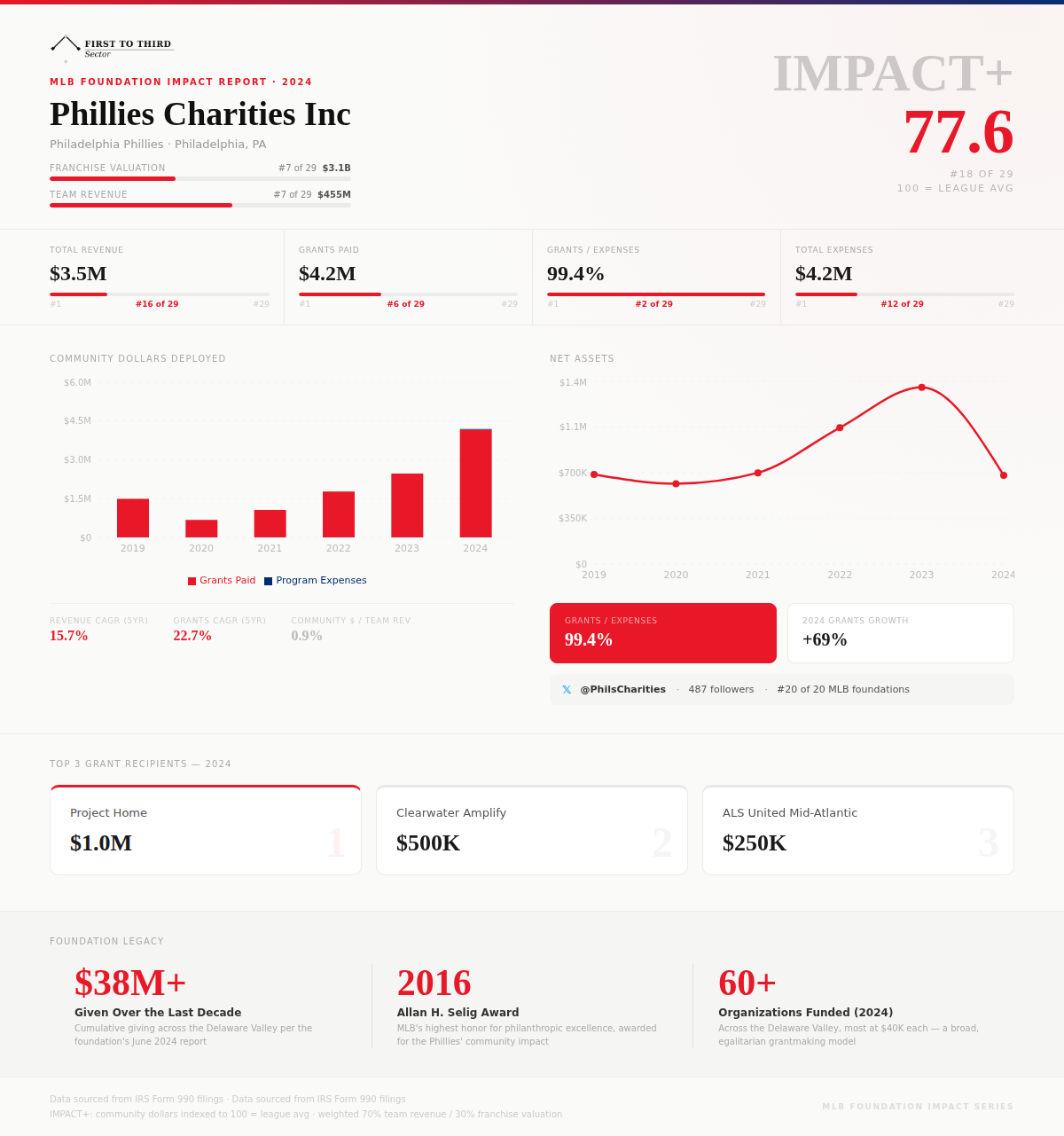
As for Phillies Charities today: they come in below average with an IMPACT+ score of 77.6 (#18 of 29), though with an upward trajectory that will be interesting to track as 2025 and 2026 data become available. Grantmaking has grown from $681K in 2020 to $4.16M in 2024 — a sixfold increase in four years. They're also essentially a pure pass-through organization: 99.4% of expenses go out the door as grants, second only to the Colorado Rockies, who give out substantially less in total.
Another data point I've started tracking is the social media presence of MLB team foundations. I'll share the full data set at some point, but overall most teams are not investing here — foundation accounts have tiny followings compared to the main team accounts. The Phillies are an extreme case: @PhilsCharities has 487 followers on X, last among the 20 foundation accounts I've tracked.
Lastly, and I noted this when launching this series, it can be difficult to measure everything a team or foundation does in support of good causes. At the time, I highlighted the Boston Red Sox and their partnership with the Jimmy Fund. With the Phillies, the team runs the Phillies MLB Urban Youth Academy — a free, multi-site academy providing year-round instruction to the 8,000+ Phillies RBI players — jointly with MLB and Philadelphia Parks & Recreation, on city-owned property. The team-side program costs (RBI coaching, Academy staff, instruction) never appear on the foundation's 990. That's a contrast with teams like the Dodgers and Giants, which operate and pay for similar programs through their foundations. Neither approach is wrong, but it's a reminder that 990 data alone understates what some organizations actually invest in their communities.
All of this makes the Phillies one of the more interesting foundations to watch over the next two years: a fast-growing grantmaker, an All-Star Legacy investment on the way, and a hometown spotlight that tends to bring donor money with it. More on the Legacy Initiative's 29-year history tomorrow.