
Giants Community Fund
Last fall, I happened to meet someone who has been involved with the San Francisco Giants and the Giants Community Fund for a number of years (he happened to be wearing his World Series ring at the time, and I got to hold it!). I mentioned the idea of this project, and he 1) thought it was interesting and 2) talked about the great work the Giants Community Fund does and how there have been people in from the league and other teams to learn from them. So going into this, I was very curious to know how they would rank on my IMPACT+ metric, and they rate well with a 131.2, landing them #8 of 29.
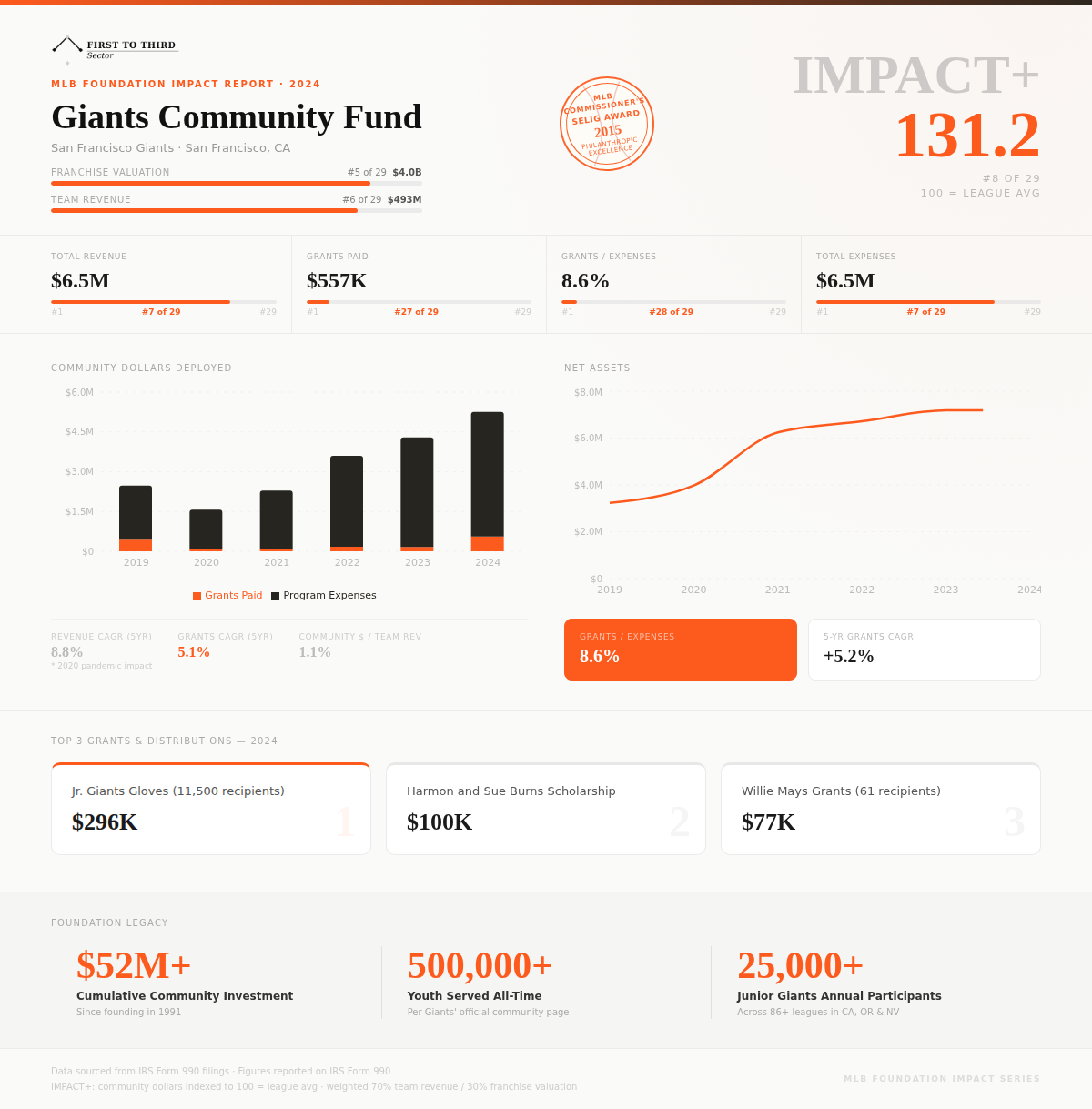
As this graphic makes clear, the story isn't their raw number; rather, it's how they seek to make an impact. This is the 13th snapshot I've written, and the Giants have the lowest grants/expenses ratio of any foundation I've profiled so far (teaser: the Nationals have the lowest, and that one is coming next), meaning that the bulk of their efforts are focused on their direct programs. Interestingly, the Dodgers Foundation spent more money on direct programs (over $5.5M), but their overall community dollars deployed is much higher as they also have a robust grantmaking operation, which makes their ratio 32%.
The Giants run the opposite model. In 2024, they paid out $557K in actual grants — just 8.6% of their $6.5M in total expenses. The other 90%-plus goes to running their own programs directly: Junior Giants, the flagship youth baseball and softball league, cost $2.3M in direct expenses alone in 2024. Add the Willie Mays Scholars program, Junior Giants Schools, field renovations, and a handful of other in-house efforts, and direct program spending hit $4.7M in 2024 — up from $2.0M just five years earlier.
It appears this has been the model for quite some time too. Grants have never topped $434K in any year back to 2019, while direct program spending has climbed steadily every year since, roughly doubling over that stretch. Junior Giants alone now serves 25,000+ kids annually across 86 leagues in California, Oregon, and Nevada — all of it staffed, equipped, and operated by the Fund itself rather than handed off to a partner organization.
Seeing this data made me think that perhaps they would then focus more on building an endowment to have a more predictable income stream so they can continue growing these direct programs. But this hypothesis was wrong. The Giants Community Fund ranks 13th in total assets and 10th in investment income with less than 4% of their budget covered by that revenue stream. So they are more like a traditional nonprofit, needing current use revenue to continue running their programs.
There's no one right way to run a foundation. Most teams write checks. The Giants build and staff the thing themselves, and the IMPACT+ score says that approach works well. But for all the nonprofits in the Bay Area, looking for grants from the Giants Community Fund will not likely be fruitful, but that doesn't mean the people you serve aren't being impacted by them in other ways.